Fly to Apophis in 2029
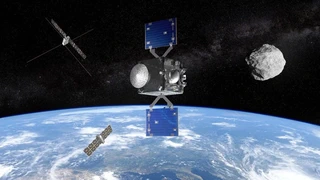
The Student-led Threatening Asteroid Reconnaissance of Tsinghua (START) is a low-cost, rapid-response minisatellite mission designed to investigate the near-Earth asteroid (99942) Apophis. During its Earth close approach in April 2029, Apophis will experience significant terrestrial tidal forces, providing an unprecedented opportunity to observe the real-time physical and dynamical evolution of a rubble-pile asteroid. The 200-kg spacecraft is scheduled to be launched as a secondary payload into low Earth orbit in early 2028, and then utilize solar electric propulsion to autonomously transfer to a 38,000-km geocentric orbit. START will execute a high-speed flyby of Apophis wtih a closest approach of 7 km at its perigee. The payload suite consists of a high-resolution narrow-field camera, a wide-field navigation camera, and dual visible-to-near-infrared hyperspectral imagers. By acquiring centimeter-scale imagery and reflectance spectra, the mission will characterize the asteroid’s surface morphology and composition, monitor immediate tidally induced surface modifications, and constrain its internal structure. Ultimately, START will provide geometrically complementary, high-cadence datasets to international flagship missions during the highly dynamic perigee passage, demonstrating a highly scalable and cost-effective architecture for future planetary defense and small-body exploration.
Y. Wu, Y. Li, B. Zheng, …, Y. Jiao, et al. The START mission: probing the 2029 Apophis flyby via a low-cost geocentric smallsat. The Planetary Science Journal (under review)
