Origin of Saturn's rings
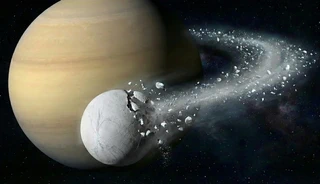
The origin of Saturn’s rings has been debated for decades. Measurements from Voyager and Cassini have suggested that the rings could be as young as ~100 Myr and composed of nearly pure water ice. Several scenarios have been proposed to explain these properties. One hypothesis is that the rings formed through the recent tidal disruption of a pre-existing moon, Chrysalis, which experienced a close encounter with Saturn following its highly eccentric orbit. However, the mechanism by which this hypothesis would have formed the rings remains largely unexplored, in particular, whether Chrysalis could supply ring material of the desired mass and composition. To address these questions, we perform smoothed particle hydrodynamics simulations to investigate the tidal response of Chrysalis during close encounters with Saturn. Our results demonstrate that preferential tidal stripping of the ice mantle from a differentiated Chrysalis can produce rings with both mass and composition resembling the present rings, provided that the closest encounter occurs between the parabolic Roche limits for ice ~1.53 $R_S$ and rock ~1.07 $R_S$. Moreover, multiple close encounters can extend the effective disruption limit by spinning up the body, enhancing the tidal stripping efficiency. Following close encounters, the rocky remnant of Chrysalis would have been removed in less than few kyr, either by collision with Saturn or ejection onto a hyperbolic orbit. These findings support the hypothesis that Saturn’s rings could originate from a recent lost moon, and imply a highly dynamical evolution of the Saturnian system over the past few hundred million years.
Y. Jiao, F. Nimmo, J. Wisdom, et al. Investigating tidal stripping of a pre-existing moon as the origin of Saturn’s young icy rings. The Astrophysical Journal Letters (accepted)
